Choosing a driveway surface is usually the first decision people make, and it’s the one they ask us about most. The surface is what you see every day, but how long a driveway lasts depends far more on what’s underneath it. Any of the options below will look good on day one. The difference shows after a few winters, and that comes down to excavation, sub-base and drainage. You can read more about that in our guide to how a driveway should be built.
With that in mind, here’s how the four most popular surfaces compare.
| Block paving | Tarmac | Resin bound | Gravel | |
|---|---|---|---|---|
| Look | Huge choice of colours and patterns | Clean, plain and practical | Smooth, seamless and modern | Natural and informal |
| Drainage | Permeable versions available | Needs falls and drainage | Permeable when laid on a permeable base | Naturally permeable |
| Upkeep | Occasional weeding and re-sanding of joints | Very little | Very little, an occasional wash | Raking and topping up |
| Repairs | Easy: individual blocks can be lifted and relaid | Patches can show | Patches can show | Easy |
| Relative cost | Mid to high | Usually the lowest | Mid to high | Low |
Block paving
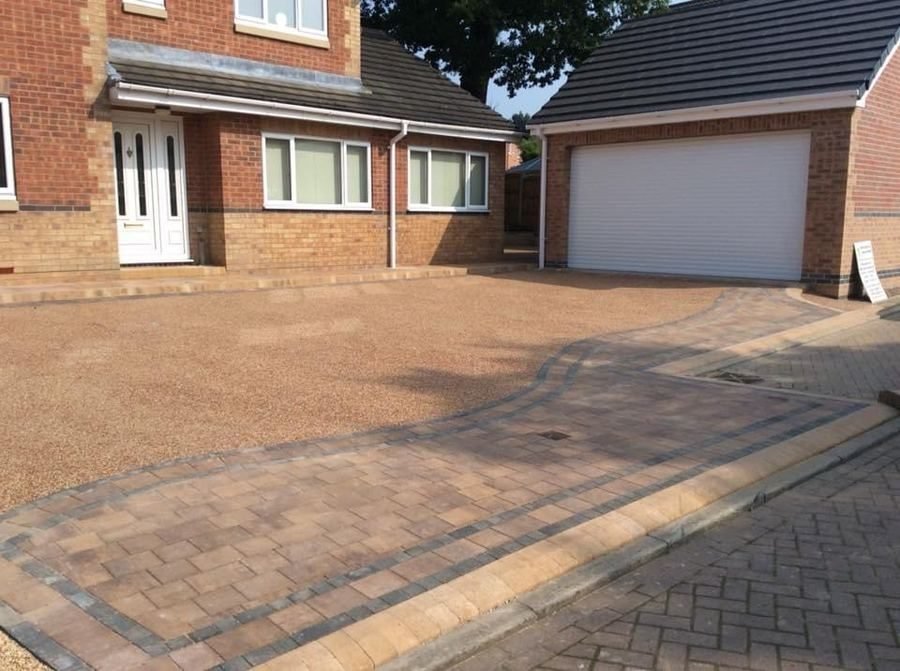
Block paving is still the most popular driveway in the UK, and for good reason. It comes in dozens of colours and textures, can be laid in herringbone, basketweave or random patterns, and works on both period and modern homes. A charcoal or contrasting border makes even a simple driveway look finished.
The big practical advantage is repair. If a section sinks or a utility company needs to dig it up, the blocks can be lifted, the base put right and the same blocks relaid. On clay ground, such as much of the Horsham, Crawley and Billingshurst area, that peace of mind is worth having.
Watch out for: paving laid on too little sub-base, and edges that aren’t set in concrete. Both lead to sinking and spreading.
Tarmac
Tarmac is tough, quick to lay and usually the most cost-effective option per square metre, especially on larger or longer drives. A block paved or brick edge lifts the appearance a lot for a small extra cost.
Standard tarmac is not permeable, so on a front garden it needs to drain to a lawn, border or soakaway, or it may need planning permission. See our planning permission guide. It can also soften slightly in very hot weather, so it’s worth avoiding sharp steering on a stationary car in the first summer.
Resin bound
Resin bound is a mix of natural aggregate and clear resin, trowelled to a smooth, joint-free finish. It’s permeable when laid over a permeable base, needs very little maintenance and gives a high-end look. Colour choice is wide, from natural golds and browns to silvers and greys.
Resin is only as good as what it’s laid on. It needs a solid, well-prepared base, usually open-graded asphalt or concrete over a compacted sub-base. Putting resin straight onto an old cracked driveway is a common shortcut that leads to cracks coming through. We always prepare a proper base first.
Gravel
Gravel is the most affordable option and drains naturally, so it never needs planning permission for drainage reasons. Laid loose, it migrates onto lawns and the road and can rut. Laid in a stabilising grid over a proper sub-base, it stays level and is far more practical, especially for long country drives.
So which is best?
- Lowest cost for a large area: tarmac or gravel in a grid
- Most choice of style, easiest to repair: block paving
- Lowest maintenance with a modern look: resin bound
- Simplest route around planning rules: permeable block paving, resin bound or gravel
Ground conditions matter too. Clay soils in the Weald need deeper excavation and careful drainage, while the sandy ground around Storrington, Bordon and Godalming drains well but needs firm edging. We’ll talk through the options at a free visit and bring samples so you can see them against your house.
Want advice on your own project?
Send a few photos and rough measurements for a free guide price, or book a free site visit. We cover West Sussex, Surrey and Hampshire.