
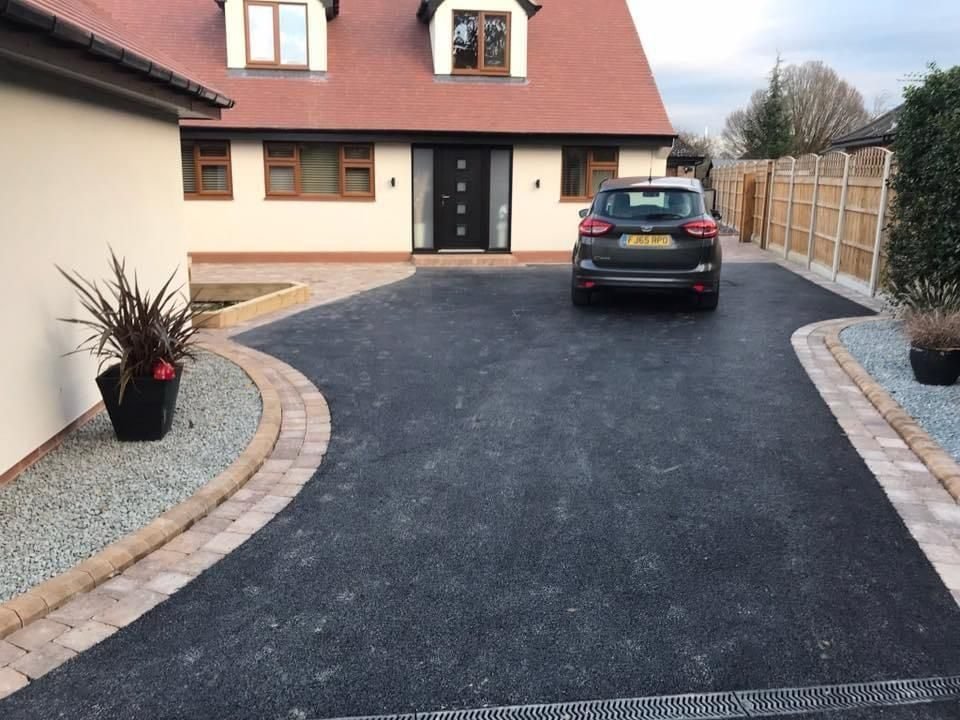
Most new driveways don’t need planning permission, but some do, and getting it wrong can mean being asked to dig up a brand new drive. Here’s a plain-English summary of the rules for houses in England, and who to contact locally. It’s general guidance rather than legal advice, so if your situation is unusual, check with your council first.
The basic rule for front gardens
Since 2008, houses in England can pave over a front garden without planning permission, as long as one of these applies:
- the new surface is permeable or porous, such as permeable block paving, resin bound on a permeable base, or gravel, or
- rainwater from the surface is directed to a permeable area within your property, such as a lawn, flower bed or soakaway.
If you want a traditional non-permeable surface, such as standard tarmac or concrete, that drains onto the road, and the area is more than 5 square metres, you will need planning permission.
In practice, most of our driveways are designed so permission isn’t needed, by choosing a permeable finish or adding drainage to a soakaway or border.
When the normal rules don’t apply
- Flats and maisonettes don’t have the same permitted development rights, so permission is often needed.
- Listed buildings may need listed building consent for changes to the front garden, walls or railings.
- Conservation areas and some streets have an Article 4 direction that removes permitted development rights. Many town centres in our area, including Chichester, Petworth, Farnham, Reigate and Dorking, have conservation areas.
- New-build estates sometimes have planning conditions or covenants restricting changes to frontages.
- Removing a front wall or hedge can also need consent in some locations.
Dropped kerbs are a separate application
If you need a new dropped kerb, or want to widen an existing one, you must apply to the county council as highway authority. This is separate from planning permission. The council checks visibility, the width of the verge and footpath, and any trees, lamp posts or street furniture in the way. They’ll also tell you who can carry out the kerb works.
Where the road is a classified road, such as an A or B road, you’ll usually need planning permission for the new access too.
Who to contact locally
| Area | Planning (driveway) | Dropped kerb |
|---|---|---|
| Horsham, Billingshurst, Pulborough, Storrington | Horsham District Council | West Sussex County Council |
| Chichester and villages | Chichester District Council | West Sussex County Council |
| Petworth and South Downs villages | South Downs National Park Authority | West Sussex County Council |
| Bognor Regis | Arun District Council | West Sussex County Council |
| Worthing | Worthing Borough Council | West Sussex County Council |
| Crawley | Crawley Borough Council | West Sussex County Council |
| Haywards Heath | Mid Sussex District Council | West Sussex County Council |
| Redhill, Reigate | Reigate and Banstead Borough Council | Surrey County Council |
| Dorking, Leatherhead | Mole Valley District Council | Surrey County Council |
| Farnham, Godalming | Waverley Borough Council | Surrey County Council |
| Havant, Emsworth, Waterlooville | Havant Borough Council | Hampshire County Council |
| Bordon | East Hampshire District Council | Hampshire County Council |
How we help
At the quote visit we’ll look at the size of the area, where the water will go and whether a dropped kerb is involved. We’ll then recommend a design that keeps you within the rules wherever possible. If you do need to apply, we can give you a written specification of the surface and drainage to include with your application.
Want advice on your own project?
Send a few photos and rough measurements for a free guide price, or book a free site visit. We cover West Sussex, Surrey and Hampshire.