
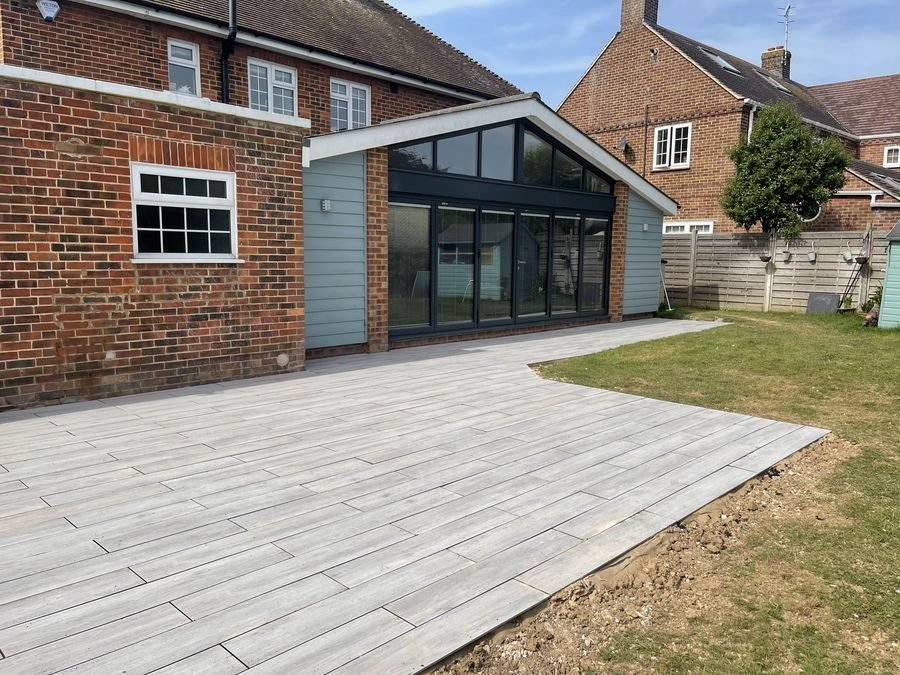
Indian sandstone and porcelain are the two most popular patio materials we lay. Both look great and both last for decades when they’re laid properly. They suit different gardens and different people, so here’s how to choose.
Indian sandstone
Sandstone is a natural stone, so no two slabs are the same. Riven sandstone has a textured, slightly uneven surface with natural colour variation, from the warm buffs and golds of Fossil Buff and Autumn Brown to the greys of Kandla Grey. Sawn sandstone has smooth faces and crisp edges for a more contemporary look.
- Pros: natural look that softens with age, good grip when riven, usually cheaper than porcelain, easier to cut and shape around curves.
- Cons: can mark and weather, needs more cleaning in shady or damp gardens, and colours can vary from the sample.
Porcelain
Outdoor porcelain is a dense manufactured tile, usually 20mm thick, printed to look like stone, concrete or even wood. It absorbs almost no water, so it resists staining, moss and algae far better than natural stone.
- Pros: very low maintenance, colour stays consistent, sharp modern look, excellent in shaded gardens.
- Cons: usually costs more to buy and lay, is harder to cut, and needs a priming slurry on the back of every slab so it bonds to the mortar.
Side by side
| Indian sandstone | Porcelain | |
|---|---|---|
| Look | Natural, varied, traditional or contemporary | Uniform, crisp, modern |
| Maintenance | Occasional clean, optional sealing | Very little |
| Shady or damp gardens | Can go green without cleaning | Excellent |
| Relative cost | Lower | Higher |
| Best for | Cottage and period gardens, curves, budget | Modern homes, low upkeep, shade |
How it’s laid matters most
Whichever you choose, a patio should be laid on a full mortar bed over a compacted sub-base, not on five dabs of mortar, which leaves hollow spots that crack and rock. It needs a gentle fall away from the house so water drains off, and it must sit at least 150mm below the damp-proof course. Joints should be filled with a proper jointing compound or mortar so weeds can’t take hold.
That’s how we lay every patio, and it’s why we can offer a five-year guarantee on our workmanship.
Still undecided?
We’re happy to bring samples of both to your free quote visit so you can see them in your own garden light. Shade, children, pets and how much time you want to spend cleaning usually settle it.
Want advice on your own project?
Send a few photos and rough measurements for a free guide price, or book a free site visit. We cover West Sussex, Surrey and Hampshire.